
Drinking Regularly — What It Does to Your Labs
You drink most days or most weekends, you are cutting back, or a routine panel showed a raised liver enzyme or large red cells and you want the full picture alcohol leaves in blood.
- Tests9
- With code$338.40
Order it in one cart
One draw at a Quest lab near you, no doctor’s visit. The prices are Marek’s own, with code CAMERON applied.
$338.40$376.00with code CAMERON
Drawn at any Quest location in the US, no doctor’s visit (not NY, NJ or RI). Marek’s checkout adds its one-time blood-draw fee to individual tests and shows the total before you pay.
What is in it
9 tests: $376.00 before the code, $338.40 with code CAMERON. Every marker links to its own free page.
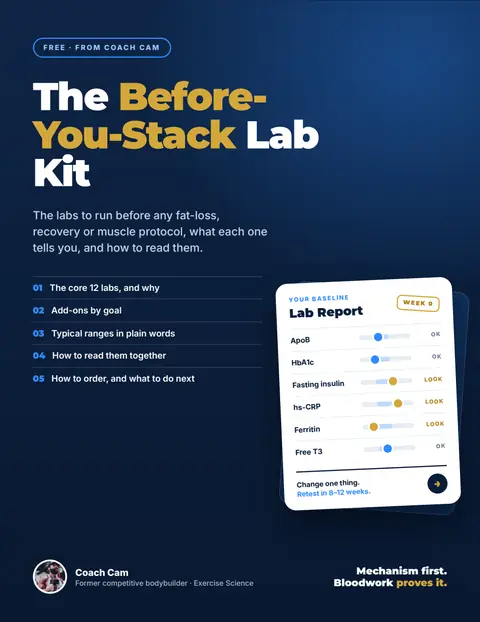
The free Before‑You‑Stack Lab Kit
The 12 labs I’d run before any protocol, what each one tells you, add-ons by goal and how to order them yourself. The PDF is yours straight away.
After that it is about two emails a week: a marker, a compound or a protocol. Unsubscribe in one click.
Before you order
Why these markers
Who it is for, what it answers, what most people miss
- Who it is for
You drink most days or most weekends, you are cutting back, or a routine panel showed a raised liver enzyme or large red cells and you want the full picture alcohol leaves in blood.
- What it answers
Alcohol leaves a recognizable signature in blood: liver enzymes, triglycerides, uric acid, red cells that grow larger (a raised MCV), and depleted B vitamins and magnesium. This panel reads that whole signature at once, which says more than any single liver value, and gives you a baseline to watch improve as you cut back.
- What most people miss
Large red cells (a high MCV on the CBC) are one of the most specific blood signs of regular drinking, and they take about three months to normalize after cutting back, which makes them a slow, honest progress marker. Thiamine (vitamin B1) is the shortfall that matters most and is the one almost never tested. If you drink heavily every day, stopping suddenly can be dangerous: cut back with medical support.
How to prepare, and what skews it
27 things can skew it
When and how to get it drawn
Morning, fasted 9–12 hours. No alcohol for at least 48 hours before the draw; a few drinks the night before raise triglycerides and uric acid on their own. Repeat after three months of cutting back to see the change.
What skews the result
Some of these change your real level; others only change the reading. Each one says what to do.
- Hemolysis (burst red cells)Assay
Red cells rupturing in the tube spill their contents into the serum. Potassium, LDH, AST and magnesium are far higher inside cells than outside, so a hemolyzed sample reports them falsely high. Caused by a difficult draw, a narrow needle, or shaking the tube.
Do this: The lab usually flags it. If your result is odd and the report mentions hemolysis, that is your answer — repeat the draw.
Affects: Comprehensive Metabolic Panel (CMP), Magnesium, RBC- Acute illness or infectionPhysiological state
This is an acute-phase reactant — it moves substantially during any infection, injury or inflammatory episode, and the change has nothing to do with your baseline.
Do this: Wait two weeks after any illness, vaccination or injury before drawing or interpreting.
Affects: Complete Blood Count (CBC) with Differential, Enhanced Liver Fibrosis (ELF) Test- Fist clenching and tourniquet timeSample prep
Clenching your fist pumps potassium out of muscle and can raise a measured potassium enough to trigger a false alarm. A long tourniquet concentrates protein, calcium and everything protein-bound.
Do this: Do not pump your fist. Ask for the tourniquet to come off early. An isolated high potassium with no symptoms is usually this.
Affects: Comprehensive Metabolic Panel (CMP)- Creatine supplementationDrug or supplement
Raises creatinine — a breakdown product of creatine — without harming the kidney at all. This is one of the most common false alarms in this audience, and it also drags the calculated eGFR down.
Do this: Expect it if you supplement creatine or carry muscle. Cystatin C settles it, because it is independent of muscle.
Affects: Comprehensive Metabolic Panel (CMP)- Recent hard trainingPhysiological state
Muscle damage and the inflammatory response to hard exercise shift this for days afterwards.
Do this: No hard or unfamiliar training for 48–72 hours before the draw.
Affects: Comprehensive Metabolic Panel (CMP)- DehydrationPhysiological state
Concentrates the blood and falsely raises hemoglobin, hematocrit and red cell count. Genuinely important on TRT, where a hematocrit near the ceiling changes management.
Do this: Hydrate normally the day before. Do not over-drink immediately before either — that dilutes in the other direction.
Affects: Complete Blood Count (CBC) with Differential- Recent hard training or endurance sportPhysiological state
Plasma volume expands with endurance training, diluting hemoglobin — 'athlete's pseudoanemia', which is an adaptation and not a deficiency. White cells also rise acutely after hard exercise.
Do this: Distinguish it by a normal ferritin. Draw 48–72 hours after hard work.
Affects: Complete Blood Count (CBC) with Differential- Delay before the sample is runSample prep
Platelet clumping in the EDTA tube produces a falsely low platelet count, and cells swell over time, shifting indices.
Do this: A surprisingly low platelet count with no symptoms is usually clumping. Ask for a citrate tube repeat.
Affects: Complete Blood Count (CBC) with Differential- Fasting vs non-fastingTiming
Triglycerides rise substantially after eating; total and HDL cholesterol barely move. Because LDL is usually calculated from triglycerides, a non-fasted draw distorts the LDL too — and the error is worst in exactly the people with high triglycerides.
Do this: Fast 10–12 hours if LDL matters. Guidelines increasingly accept non-fasting lipids, but be consistent between tests.
Affects: Lipid Panel (Cholesterol, HDL, LDL, Triglycerides)- Recent illness, injury or surgeryPhysiological state
Cholesterol falls during acute illness and can stay low for weeks — a lipid panel after a hospital admission understates your true level.
Do this: Wait six weeks after any significant illness or surgery.
Affects: Lipid Panel (Cholesterol, HDL, LDL, Triglycerides)- Acute weight loss or a very low-carbohydrate dietPhysiological state
Active fat loss mobilizes lipids and can transiently raise LDL. Some people show a striking LDL rise on ketogenic diets.
Do this: Measure at weight stability, not mid-cut.
Affects: Lipid Panel (Cholesterol, HDL, LDL, Triglycerides)- Testosterone and anabolic steroidsDrug or supplement
Lower HDL substantially, and oral 17-alpha-alkylated compounds do so dramatically.
Do this: Expect it on TRT; note it rather than being alarmed by it in isolation.
Affects: Lipid Panel (Cholesterol, HDL, LDL, Triglycerides)- Recent alcohol, fasting or a purine-heavy mealTiming
Beer and spirits raise urate sharply; so does fasting, because ketones compete for renal excretion. A crash diet can precipitate gout.
Do this: Fasted but not after a prolonged fast, and no alcohol for 48 hours.
Affects: Uric Acid- Diuretics, low-dose aspirin, niacinDrug or supplement
Thiazide and loop diuretics reduce urate excretion, low-dose aspirin does the same, and niacin raises it — while losartan lowers it, which is why it is often chosen in hypertensive gout.
Do this: Review medications before acting on a raised result.
Affects: Uric Acid- During an acute gout attackPhysiological state
Urate paradoxically falls during an attack, so a normal level does not exclude gout.
Do this: Measure at least two weeks after an attack settles.
Affects: Uric Acid- Light sensitivity and sample handlingSample prep
Thiamine degrades on light exposure and needs prompt, protected processing.
Do this: A low result from a mishandled sample is common. Whole-blood thiamine diphosphate is the better measure.
Affects: Vitamin B1 (Thiamine)- Alcohol, diureticsDrug or supplement
Chronic alcohol impairs thiamine absorption and storage, and loop diuretics force urinary loss — together the commonest causes of deficiency in the developed world.
Do this: Confusion, unsteadiness or eye movement problems with heavy alcohol use is a medical emergency — thiamine is given first, not after the test.
Affects: Vitamin B1 (Thiamine)- What you ate this weekTiming
Serum folate reflects recent intake — literally your last few meals. A single leafy-green dinner can normalize it.
Do this: RBC folate reflects months and is the better test. Use serum only for acute questions.
Affects: Folate, Serum- Methotrexate, some anti-epileptics, alcoholDrug or supplement
Methotrexate blocks folate metabolism directly; several anti-epileptics and chronic alcohol both deplete it over time.
Do this: Note any of these — and if you are on methotrexate, folate dosing and timing is your prescriber's decision.
Affects: Folate, Serum- Serum B12 is a poor testAssay
It measures total B12, most of which is bound to haptocorrin and unavailable to cells. You can be tissue-deficient with a normal serum B12 — which is exactly why MMA exists.
Do this: A low-normal B12 with symptoms should be confirmed with MMA, not dismissed.
Affects: Vitamin B12- Recent B12 supplements or injectionsDrug or supplement
Raise serum B12 for weeks to months while tissue status may still be poor.
Do this: Testing after supplementing tells you little. Test before, or use MMA.
Affects: Vitamin B12- High-dose biotin, and intrinsic factor antibodiesAssay
Biotin interferes with the assay; intrinsic factor antibodies can cause falsely normal or high results in exactly the people with pernicious anemia.
Do this: Stop biotin 72 hours before. MMA cuts through both problems.
Affects: Vitamin B12- MetforminPhysiological state
Impairs B12 absorption over time; a well-documented effect from the DPPOS trial.
Do this: Test B12 (and MMA if borderline) at least annually on metformin.
Affects: Vitamin B12- PPIs / acid reducersPhysiological state
Reduce stomach acid needed to absorb these nutrients.
Do this: Test B12, magnesium (RBC) and ferritin if on long-term acid suppression.
Affects: Vitamin B12- Separation delaySample prep
Magnesium leaks from cells into serum over time, so a delayed spin shifts the RBC value down and the serum value up.
Do this: Prompt processing matters. Stay with one lab.
Affects: Magnesium, RBC- Recent transfusionPhysiological state
RBC magnesium reflects the donor's cells until yours turn over.
Do this: Wait three months after a transfusion.
Affects: Magnesium, RBC- AgePhysiological state
ELF score rises with age independently of fibrosis, so thresholds validated in one age group over-call in older people.
Do this: Interpret against an age-aware threshold.
Affects: Enhanced Liver Fibrosis (ELF) Test
How to read it
What the results can and cannot tell you, with sources
High MCV with low folate or B12: the classic alcohol picture, and it recovers over months. AST clearly higher than ALT: a pattern often seen with alcohol and worth raising with a clinician. High triglycerides and uric acid: both fall quickly with less drinking. A high liver-fibrosis score: the liver needs a clinician's assessment, not just a retest.
Patterns, and where the results go
2 patterns, goals and what moves these markers
Patterns these markers can make
- Nothing is absorbing
Ferritin low · B12 low · Vitamin D low · Magnesium low · Albumin drifting down
Multiple unrelated nutrients low at once is rarely four separate dietary problems — it points at absorption. Celiac, inflammatory bowel disease, chronic PPI use, gastric surgery or low stomach acid all produce this.
Stop supplementing harder and find the cause. Celiac serology is cheap and routinely skipped. Review PPI and metformin use. The Gut Health panel is built for this picture, and fixing absorption fixes all of them at once.
- Uric acid is a metabolic marker, not just a gout number
Uric acid high · Triglycerides high · Fasting insulin high · Blood pressure creeping
Insulin resistance reduces uric acid excretion by the kidney. So a raised urate is very often a metabolic signal arriving before anyone has a painful toe.
Treat the insulin resistance and urate usually follows. Cut fructose and alcohol (beer especially). Do not start urate-lowering drugs off one reading — that is a clinical decision with its own trade-offs.
Goals this panel helps decide
In the library: what moves these markers
Questions people ask
6 answered
- What blood tests are in the Drinking Regularly — What It Does to Your Labs panel?
- 9 markers: Comprehensive Metabolic Panel (CMP), Complete Blood Count (CBC) w/ Differential, Lipid Panel, Uric Acid, Vitamin B1 (Thiamine), Blood, Folate, Serum, Vitamin B12, Magnesium, RBC, Enhanced Liver Fibrosis (ELF) Test.
- How much does the Drinking Regularly — What It Does to Your Labs panel cost?
- $376.00 before the discount, $338.40 with code CAMERON, which the order button applies automatically. Marek's checkout adds its one-time blood-draw fee to individual tests and shows the total before you pay.
- Do I need a doctor's order for these tests?
- No. These are ordered direct-to-consumer through Marek Diagnostics: you order online, walk into a Quest location, and results are emailed to you. No physician visit or insurance required. Not available in NY, NJ or RI.
- Does the Drinking Regularly — What It Does to Your Labs panel diagnose anything?
- No. A panel measures; it does not diagnose. It tells you which numbers are worth a conversation with a clinician and which explanations the results make more or less likely. Compare every value against the range printed on your own report.
- When should I get the Drinking Regularly — What It Does to Your Labs panel drawn?
- Morning, fasted 9–12 hours. No alcohol for at least 48 hours before the draw; a few drinks the night before raise triglycerides and uric acid on their own. Repeat after three months of cutting back to see the change.
- How do I read the Drinking Regularly — What It Does to Your Labs panel results?
- High MCV with low folate or B12: the classic alcohol picture, and it recovers over months. AST clearly higher than ALT: a pattern often seen with alcohol and worth raising with a clinician. High triglycerides and uric acid: both fall quickly with less drinking. A high liver-fibrosis score: the liver needs a clinician's assessment, not just a retest.
Your results, read properly
This page tells you what the panel measures and how to prepare. Skool is where your results get read and turned into a plan.
- Cam’s method for reading these results: which number to act on first, and what to retest
- The monthly Protocol Audit: your protocol read against your labs (a premium upgrade)
- Ask Cam live every Tuesday, 6pm Central
5.0 (15 reviews)1,500+ members
Want it built around you?
Educational and research purposes only. Not medical advice and not a diagnosis; a panel is a starting point for a conversation with a clinician, not a substitute for one. Lab ranges vary by assay and laboratory: compare against the range printed on your own report. Some links are affiliate links; Cam may earn a commission at no extra cost to you. Medical disclaimer and affiliate disclosure