The short version
- Why people research itDiabetic foot ulcer healing, fracture repair and ischemic or radiation-injured tissue; one randomized phase I/II human trial.
- What the evidence isOne randomized, double-blind, placebo-controlled phase I/II trial in 60 people with diabetic foot ulcers, and it was positive.
- What to watchNew or enlarging lumps, or a mole that changes.
How TP-508 works
The mechanism is measured, which is rare for repair peptides. TP508 triggers a 2- to 4-fold rise in nitric oxide in human endothelial cells within minutes, through Src, PI3K-Akt and PKC and independent of calcium, at levels similar to VEGF (Olszewska-Pazdrak 2010).
It binds an RGD-dependent site on integrin alpha-v-beta-3 and related receptors on endothelial cells and stem cells, and in human endothelial cells it drives a rapid burst of nitric oxide through Src, PI3K and Akt. That nitric oxide signal is the common thread behind its reported actions: more new vessels, restored endothelial function, faster fracture and wound repair, and protection of the gut lining and endothelium after radiation in mice. The human data come from a diabetic foot ulcer trial published in 2007.
- Injectable
Research on TP-5086 evidence notes: clinical, correlative, mechanism
Each note is labeled by the kind of evidence it stands on. Unproven is not ineffective: a missing trial means nobody has run it yet. How the evidence tiers work
Evidence on file: Human (randomized, double-blind phase I/II in diabetic foot ulcers); animal and cell work for fracture, ischemia and radiation injury.
Human clinical evidence
One randomized, double-blind, placebo-controlled phase I/II trial in 60 people with diabetic foot ulcers, and it was positive. Topical TP508 applied with standardized care and offloading more than doubled the incidence of complete healing, increased mean closure rate by about 80% and cut the median time to full closure by about 40%, all at p<0.05 in the per-protocol population, with heel ulcers doing best (6 of 7 healed against 0 of 5 on placebo). Adverse events matched placebo and there were no drug-related lab changes or serious events (Fife 2007).
What the trial does not give you. It is early phase, 60 people, per-protocol results carry the headline, and the effect was topical on the ulcer surface. No larger confirmatory trial has been published, and no human fracture trial result was found in PubMed on 10 Nov 2026. The honest read is a credible early signal that never got its second trial.
Correlative data
A development history, not a practice history. Chrysalin was tested in the 2007 diabetic foot ulcer phase I/II trial and later studied as a radiation countermeasure, with authors from OrthoLogic and then Chrysalis BioTherapeutics on the papers. There is no off-label clinical series or registry.
How the mechanism reads
The mechanism is measured, which is rare for repair peptides. TP508 triggers a 2- to 4-fold rise in nitric oxide in human endothelial cells within minutes, through Src, PI3K-Akt and PKC and independent of calcium, at levels similar to VEGF (Olszewska-Pazdrak 2010). It binds an RGD-dependent site on integrin alpha-v-beta-3, and reversed endothelial dysfunction in a pig ischemia model with sixteen-fold perfusion gains in ischemic regions (Fossum 2008).
Experimental, animal or cellFracture and radiation work extends the same logic. A single injection accelerated rat fracture repair with more callus vessels and an early growth-factor gene response (Wang 2005), and given a day after lethal radiation it protected intestinal crypts and endothelial function in mice (Kantara 2015, Olszewska-Pazdrak 2016).
Experimental, animal or cellThe predicted downside follows the mechanism. Anything that drives angiogenesis can feed a tumor's blood supply and anything derived from thrombin sits near the clotting system. Neither has been reported as a problem in the published human trial, but the trial was small and short, so the downside is unmeasured rather than excluded.
Mechanistic
TP-508 safety basicsWho should avoid it, what to expect, what to watch
Avoid if
- Active cancer or a recent cancer history, because the repair signal works by promoting new blood vessel growth.
- A clotting disorder, a recent clot or anticoagulant treatment, since it is derived from thrombin and acts on endothelium.
- Proliferative diabetic eye disease or other abnormal vessel growth in the eye.
- Pregnancy or breastfeeding, where angiogenic signals are part of normal fetal growth.
What’s expected
- Wound or injection-site reactions at a rate similar to placebo in the one randomized trial.
- Slow, visible change in an ulcer or fracture site over weeks, if it works at all.
Watch for
- New or enlarging lumps, or a mole that changes.
- Calf pain or swelling, or sudden breathlessness (clot signs).
- Redness, warmth or pus around a wound.
Labs that tell you it’s working
- D-dimer: a clot-turnover marker for a thrombin-derived molecule.
- Fibrinogen: tracks the coagulation side of the vascular effect.
- HbA1c: for a diabetic ulcer, glucose control decides healing more than any peptide.
- hs-CRP: shows whether wound inflammation is settling.
Thrombin-derived peptide that raises endothelial nitric oxide and promotes angiogenesis; the one placebo-controlled trial found no drug-related lab changes. PMID 17244316 PMID 19893317 PMID 18757834
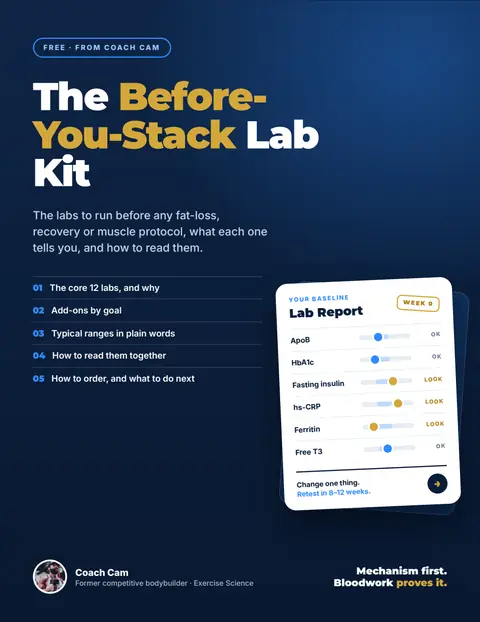
Bloodwork to runHow you would know it is working: 8 tests in one order, code CAMERON
A panel picked from how it works and what it can move: the tests, and why each is on it.
Code CAMERON applies automatically. The before and after schedule and how to read the results are in the Skool lesson.
TP-508 FAQ4 common questions
- Is TP-508 approved for human use?
- No. TP-508 is a research compound.
- What is TP-508 researched for?
- Diabetic foot ulcer healing, fracture repair and ischemic or radiation-injured tissue; one randomized phase I/II human trial.
- Which labs show whether it's doing anything?
- D-dimer; Fibrinogen; HbA1c; hs-CRP: a baseline before you start and a recheck after. The panel on this page orders them in one cart.
- Where's the full protocol?
- In the Skool lesson for TP-508: the protocol, dose and schedule, timing, what to stack, the cycle answer, the bloodwork plan and the cheat sheet. Protocol & dosing live there, not on the public site.