The short version
- Why people research itApproved antiparasitic for strongyloidiasis, onchocerciasis and scabies; COVID-19 trials showed no outpatient benefit.
- What the evidence isFor parasites the evidence is about as strong as it gets.
- What to watchConfusion, loss of coordination or seizures, which signal toxicity.
How Ivermectin works
The parasite mechanism is clean and explains the safety margin. Ivermectin opens a glutamate-gated chloride channel that nematodes have, first cloned from C. elegans, and humans do not express that channel (Cully 1994).
Those channels were first cloned from the nematode C. elegans in 1994. People do not have the same glutamate-gated channel, which is the basis of the drug's safety margin; it also acts on some GABA receptors in invertebrates. Beyond parasites, laboratory studies report effects on Wnt signaling and epithelial-to-mesenchymal transition in cancer cell lines, and antiviral activity in vitro, at concentrations that the treatment trials did not show translate to patients.
- Oral
On the goal map: Overgrowth, dysbiosis & antimicrobials (Gut health & digestion)
Research on Ivermectin4 evidence notes: clinical, correlative, mechanism
Each note is labeled by the kind of evidence it stands on. Unproven is not ineffective: a missing trial means nobody has run it yet. How the evidence tiers work
Evidence on file: Human (approved antiparasitic; randomized trials and a Cochrane review in COVID-19; population studies of mass treatment); cell work in cancer and viral models.
Human clinical evidence
For parasites the evidence is about as strong as it gets. Roughly 250 million people take it each year for onchocerciasis, filariasis, strongyloidiasis, scabies and lice. For COVID-19 the question has been tested and the answer is in. The ACTIV-6 platform trial randomized 1,591 US outpatients: no improvement in time to recovery (hazard ratio 1.07) and 10 versus 9 hospitalizations or deaths (Naggie 2022). A Cochrane review of 11 registered trials found it probably has little or no effect on mortality in outpatients (moderate certainty) and no effect on quality of life (high certainty) (Popp 2022).
Correlative data
Mass-treatment programs show what it does in populations. In Esmeraldas, Ecuador, annual ivermectin given for onchocerciasis reduced strongyloidiasis prevalence from 6.8% to zero while untreated areas stayed at 16 to 24% (Anselmi 2015). Resistance in some parasites is emerging and is a reason programs watch use patterns.
How the mechanism reads
The parasite mechanism is clean and explains the safety margin. Ivermectin opens a glutamate-gated chloride channel that nematodes have, first cloned from C. elegans, and humans do not express that channel (Cully 1994). The repurposing claims are the part that is speculative. In breast cancer cell lines it reduced proliferation, motility and invasion through Wnt signaling at micromolar concentrations (Rujimongkon 2025), and antiviral activity was seen in vitro. Those concentrations are not shown to occur in patients, and the COVID-19 outpatient trials did not find a clinical effect.
Experimental, animal or cellNeurotoxicity appears when drug accumulates, for example with impaired blood-brain barrier efflux, and animal-formulation products are a recurring source of overdose. Mass-treatment programs have been cautious around heavy infection with the African eye worm for the same reason.
Experimental, animal or cell
Ivermectin safety basicsWho should avoid it, what to expect, what to watch
Avoid if
- Heavy infection with the African eye worm, or time in regions where it occurs, because killing the microfilariae can cause a severe reaction.
- Pregnancy, unless a clinician has weighed it, since safety data are limited.
- Taking warfarin or other drugs sensitive to altered gut flora or liver metabolism.
- Using veterinary or animal-formulation products, which are a recurring source of overdose.
What’s expected
- Itching, mild rash, dizziness or a day of tiredness as parasites die.
- For scabies or lice, itch that persists for days after the parasites are gone.
Watch for
- Confusion, loss of coordination or seizures, which signal toxicity.
- Severe skin reactions or blistering.
- Fever with muscle pain after treatment.
Labs that tell you it’s working
- Complete Blood Count with differential: eosinophil count is the lab that tracks a parasitic infection.
- Comprehensive Metabolic Panel: liver enzymes for a drug cleared through the liver.
- hs-CRP: general inflammation context.
Glutamate-gated chloride channel drug with an approved antiparasitic indication; the safety question is overdose and the eye-worm reaction. PMID 7935817 PMID 31071469 PMID 26540412
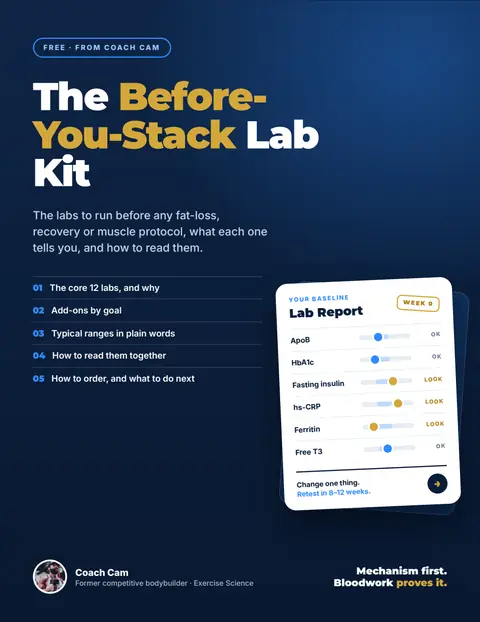
Bloodwork to runHow you would know it is working: 5 tests in one order, code CAMERON
A panel picked from how it works and what it can move: the tests, and why each is on it.
Code CAMERON applies automatically. The before and after schedule and how to read the results are in the Skool lesson.
Ivermectin FAQ4 common questions
- Is Ivermectin approved for human use?
- Ivermectin is an approved medicine for the uses on its label. This page covers research beyond those uses, as education, not medical advice.
- What is Ivermectin researched for?
- Approved antiparasitic for strongyloidiasis, onchocerciasis and scabies; COVID-19 trials showed no outpatient benefit.
- Which labs show whether it's doing anything?
- Complete Blood Count with differential; Comprehensive Metabolic Panel; hs-CRP: a baseline before you start and a recheck after. The panel on this page orders them in one cart.
- Where's the full protocol?
- In the Skool lesson for Ivermectin: the protocol, dose and schedule, timing, what to stack, the cycle answer, the bloodwork plan and the cheat sheet. Protocol & dosing live there, not on the public site.