The short version
- Why people research itFat oxidation, insulin sensitivity and neuroinflammation through PPAR-delta in animals.
- What the evidence isNo published human trial of GW-0742 was found.
- What to watchPersistent unexplained fatigue or abdominal pain.
How GW-0742 works
Every rodent result runs through PPAR-delta.
In rat hearts and cultured cardiomyocytes it raised fatty-acid oxidation and TCA-cycle gene expression in a way that was blocked by a PPARd antagonist and by siRNA, proving the receptor is the route. In diabetic rats it attenuated insulin resistance, and in mouse brain it reduced neuroinflammation after amyloid or radiation injury. It reached clinical testing as a metabolic drug, and no human result for this particular molecule has been published in the papers read.
- Oral
On the goal map: Mitochondrial & metabolic reprogramming (Lose fat)
Research on GW-07424 evidence notes: clinical, correlative, mechanism
Each note is labeled by the kind of evidence it stands on. Unproven is not ineffective: a missing trial means nobody has run it yet. How the evidence tiers work
Evidence on file: Animal and cell; no published human trial of GW-0742 itself found. Class evidence from related PPAR-delta agonists exists.
Human clinical evidence
No published human trial of GW-0742 was found. It was developed as a metabolic drug and appears in preclinical literature, but there is no randomized or open-label human study in the papers read. What is missing is a human tolerability and pharmacokinetic study. Weigh the rodent record below, and note that results for its sibling Cardarine do not automatically carry over.
No completed human trial
Correlative data
A research-supply record only. GW-0742 is sold by research vendors and discussed in performance forums; there is no clinical series or registry, and no controlled human exposure data.
How the mechanism reads
Every rodent result runs through PPAR-delta. In rat heart it increased fatty-acid oxidation and TCA-cycle gene expression, abolished by an antagonist and by siRNA (Kuo 2013); in fructose-fed diabetic rats it improved insulin sensitivity on clamp testing (Niu 2015); in mice it reduced amyloid-induced hippocampal neuroinflammation and memory deficits (An 2016), and after whole-brain irradiation it reduced microglial activation but did not rescue memory or neurogenesis (Schnegg 2013).
Experimental, animal or cellThe predicted downside comes from the class. PPAR-delta agonists drive cell proliferation programs in some tissues, and the sibling molecule GW-501516 was stopped in development after rodent cancer findings; whether GW-0742 shares that is unmeasured. Lipid shifts and liver enzymes are the markers worth tracking.
Experimental, animal or cell
GW-0742 safety basicsWho should avoid it, what to expect, what to watch
Avoid if
- Personal or family history of cancer, because PPAR-delta agonists drive proliferation programs and a sibling compound was stopped over rodent tumors.
- Pregnancy or breastfeeding, where the lipid and growth effects are untested.
- Existing liver disease, as lipid metabolism and the liver are the main targets.
- Use alongside other PPAR agonists, which stack the same receptor.
What’s expected
- No felt effect is documented in humans, so there is no expected-effect list.
- Shifts in triglycerides and HDL are the effects the mechanism predicts.
Watch for
- Persistent unexplained fatigue or abdominal pain.
- New lumps, or unexplained weight loss.
- Dark urine or yellowing.
Labs that tell you it’s working
- Lipid Panel: triglycerides and HDL are the direct PPAR-delta readout.
- Apolipoprotein B: shows whether LDL particle number moved.
- Fasting insulin and HbA1c: the insulin sensitivity story in the rat data.
- Comprehensive Metabolic Panel: ALT and AST show any lipid-handling load on the liver.
Selective PPAR-delta agonist with rodent evidence only; unmeasured human safety plus a class cancer history make this a labs-first compound. PMID 23803968 PMID 26508837 PMID 23499837
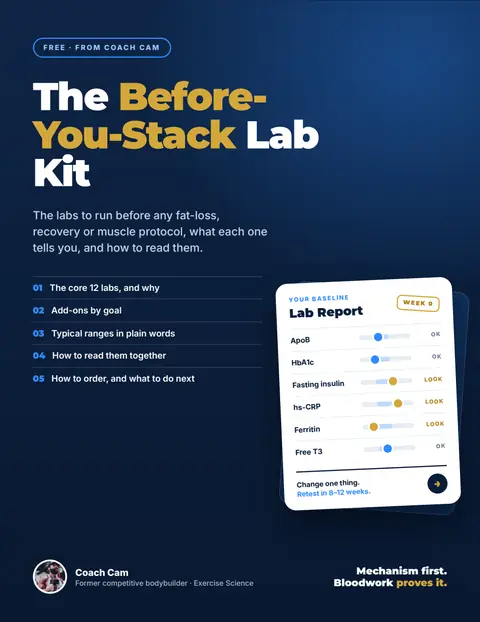
Bloodwork to runHow you would know it is working: 6 tests in one order, code CAMERON
A panel picked from how it works and what it can move: the tests, and why each is on it.
Code CAMERON applies automatically. The before and after schedule and how to read the results are in the Skool lesson.
GW-0742 FAQ4 common questions
- Is GW-0742 approved for human use?
- No. GW-0742 is a research compound. No completed randomized human trial has given it yet.
- What is GW-0742 researched for?
- Fat oxidation, insulin sensitivity and neuroinflammation through PPAR-delta in animals.
- Which labs show whether it's doing anything?
- Lipid Panel; Apolipoprotein B; Fasting insulin and HbA1c; Comprehensive Metabolic Panel: a baseline before you start and a recheck after. The panel on this page orders them in one cart.
- Where's the full protocol?
- In the Skool lesson for GW-0742: the protocol, dose and schedule, timing, what to stack, the cycle answer, the bloodwork plan and the cheat sheet. Protocol & dosing live there, not on the public site.