The short version
- Why people research itLocalized abdominal fat reduction in randomized human trials.
- What the evidence isThree published trials, one of them placebo-controlled with a clear primary endpoint.
- What to watchHard lumps, spreading redness or heat at the site.
How CBL-514 works
The mechanism predicts a local, slow and imaging-visible effect, which is what was found. Apoptosis rather than lysis should avoid the inflammatory burst of detergent-style injections, and the clearance of dead adipocytes over weeks matches the 4- and 8-week follow-up curve.
It is reported to induce apoptosis in adipocytes: the cells die in a controlled way and the contents are cleared over weeks, which is different from a detergent injection that bursts cells and inflames the area. In the three published human trials the drug was injected into the abdominal fat layer by clinicians in a grid pattern, and the readouts were ultrasound fat thickness and volume, then MRI and rating scales. The effect is local: the evidence is for reduced abdominal fat at the injected site, not body-wide weight loss.
- Injectable
On the goal map: Direct lipolysis & adrenergic drive (Lose fat)
Research on CBL-5145 evidence notes: clinical, correlative, mechanism
Each note is labeled by the kind of evidence it stands on. Unproven is not ineffective: a missing trial means nobody has run it yet. How the evidence tiers work
Evidence on file: Human (randomized phase II and phase 2b trials, abdominal subcutaneous fat).
Human clinical evidence
Three published trials, one of them placebo-controlled with a clear primary endpoint. In the 2025 phase II (76 adults, randomized 2:1 to drug or placebo). A 2026 phase 2b in 108 adults added clinician and patient scales and MRI (Lorenc 2026). The first phase IIa, found the higher levels reduced fat volume and thickness and were well tolerated (Goodman 2022).
What they do not show. All three were sponsor-run programs with clinician-delivered injections in a mapped abdominal grid, assessed by imaging. The endpoint is local fat volume, not body weight, metabolic health or durability beyond the short follow-up, and the 2025 trial was single-blind.
Correlative data
No clinical practice record outside the trials. The compound is investigational. People using vendor vials are not in a registry and are not performing the clinic procedure.
How the mechanism reads
The mechanism predicts a local, slow and imaging-visible effect, which is what was found. Apoptosis rather than lysis should avoid the inflammatory burst of detergent-style injections, and the clearance of dead adipocytes over weeks matches the 4- and 8-week follow-up curve. The prediction that matters most is the one trials cannot settle at home: injection depth, grid spacing and sterility decide whether the drug reaches fat cells at all.
MechanisticPredicted downside. Local swelling, bruising and tenderness are the expected injection-site effects, and a mass cell-death event should be watched through liver enzymes and triglycerides. Neither was a reported problem in the abstracts read, but those were small, short, supervised studies.
Mechanistic
CBL-514 safety basicsWho should avoid it, what to expect, what to watch
Avoid if
- Treating anywhere other than a mapped subcutaneous fat area: the trial effect depends on injection depth and grid.
- A liver condition or raised liver enzymes, since the body clears the contents of killed fat cells through the liver.
- Raised triglycerides or fatty liver, because mass fat-cell death releases lipid.
- An active skin infection or poor skin-healing over the target area.
- Pregnancy, breastfeeding or anything that makes self-injection into fat unsafe.
What’s expected
- Local swelling, bruising and tenderness are the effects that follow from injecting a cell-killing agent.
- Slow change in fat thickness over weeks as dead cells are cleared.
Watch for
- Hard lumps, spreading redness or heat at the site.
- Skin darkening, dimpling or tissue breakdown.
- Yellowing of the skin or dark urine.
Labs that tell you it’s working
- Lipid Panel: triglycerides are the marker for released lipid.
- Comprehensive Metabolic Panel: liver enzymes show clearance load.
- hs-CRP: tracks local inflammation spill.
Injectable that induces fat-cell apoptosis; the trial record is supervised clinic delivery, so every risk here is about procedure and clearance load. PMID 40037659 PMID 35709509 PMID 42159040
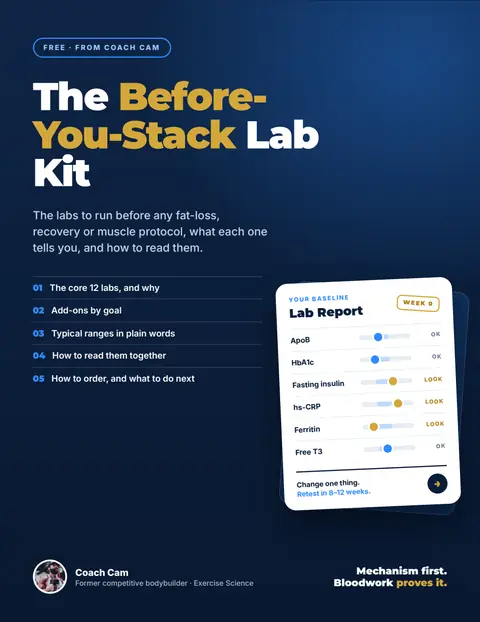
Bloodwork to runHow you would know it is working: 6 tests in one order, code CAMERON
A panel picked from how it works and what it can move: the tests, and why each is on it.
Code CAMERON applies automatically. The before and after schedule and how to read the results are in the Skool lesson.
CBL-514 FAQ4 common questions
- Is CBL-514 approved for human use?
- No. CBL-514 is a research compound.
- What is CBL-514 researched for?
- Localized abdominal fat reduction in randomized human trials.
- Which labs show whether it's doing anything?
- Lipid Panel; Comprehensive Metabolic Panel; hs-CRP: a baseline before you start and a recheck after. The panel on this page orders them in one cart.
- Where's the full protocol?
- In the Skool lesson for CBL-514: the protocol, dose and schedule, timing, what to stack, the cycle answer, the bloodwork plan and the cheat sheet. Protocol & dosing live there, not on the public site.