
TMAO (Trimethylamine N-oxide)
Also called TMAO
A metabolite produced when gut bacteria process choline, carnitine and betaine from food — then converted by the liver.
- Lab price$50.00
- Retest3–6 months after dietary change
Normal is not optimal
An emerging cardiovascular risk marker linking gut microbiome composition to atherosclerosis.
- Standard
- <6.2 µmol/L (assay dependent)
- Optimal
- Lower is generally better.
Order it yourself
One test, drawn at a Quest lab near you. The price is the lab’s, from Marek’s own menu.
Code CAMERON takes 10% off. Marek’s checkout adds its one-time blood-draw fee to individual tests and shows the total before you pay.
What moves TMAO (Trimethylamine N-oxide)
High intake of red meat, egg yolks and carnitine supplements — combined with a gut microbiome that converts them efficiently. Also kidney impairment (reduced clearance).
If it’s high: Associated with increased cardiovascular event risk in observational data. Causality is still debated — treat it as one input, not a verdict.
If it’s low: Favorable.
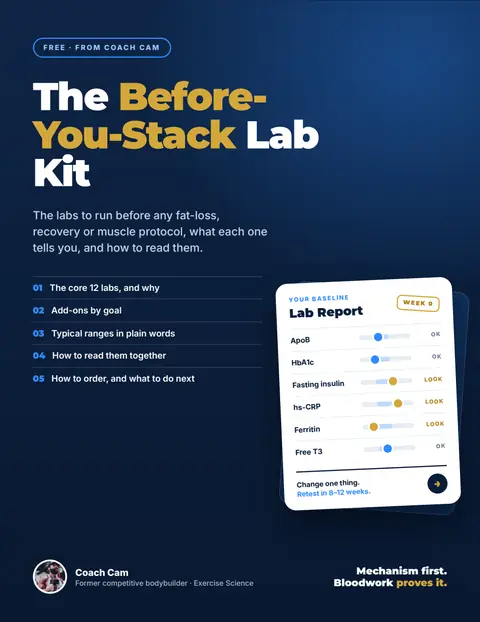
The free Before‑You‑Stack Lab Kit
The 12 labs I’d run before any protocol, what each one tells you, add-ons by goal and how to order them yourself. The PDF is yours straight away.
After that it is about two emails a week: a marker, a compound or a protocol. Unsubscribe in one click.
Everything else about TMAO (Trimethylamine N-oxide)
What can skew the result
2 things can change the reading or the real level
Some change your real level; others only change the reading. Each one says which, and what to do about it.
- What you ate in the preceding daysTiming
TMAO is produced by gut bacteria from choline and carnitine — red meat, eggs and fish. A single meal shifts it, and fish raises it sharply without the cardiovascular implication red meat carries.
Do this: Standardize your diet for 48 hours, and avoid fish for 24 hours before — otherwise the result is meaningless.
The value is real but reflects a moment — retime it- Recent antibioticsDrug or supplement
Suppress the gut bacteria that make TMAO, producing an artificially low result for weeks.
Do this: Wait at least a month after antibiotics.
A real change — account for the cause
Symptoms it helps explain
1 symptom, and which to test first
Then worth checking for
- Heart disease or stroke runs in my family
Plan of attack
What to do, in this order
- Confirm the number is real
What you ate in the preceding days. TMAO is produced by gut bacteria from choline and carnitine — red meat, eggs and fish. A single meal shifts it, and fish raises it sharply without the cardiovascular implication red meat carries. Standardize your diet for 48 hours, and avoid fish for 24 hours before — otherwise the result is meaningless.
- Read it with its partner
Fast before testing. Interpret alongside ApoB and hs-CRP rather than alone. Draw it alongside: ApoB (Apolipoprotein B), hs-CRP (High-Sensitivity C-Reactive Protein), Carnitine, Total and Free.
- Work out which direction is yours
If it's high — Associated with increased cardiovascular event risk in observational data. Causality is still debated — treat it as one input, not a verdict.
- Fix it in order: food, then cause, then everything else
Nutrition. Reduce red meat frequency; increase fiber and plant diversity to shift the microbiome. Fish and olive oil are associated with lower TMAO.
Lifestyle. Overall dietary pattern matters more than any single food. Fiber diversity is the main lever on the microbiome. - Retest
3–6 months after dietary change. Change one thing at a time, or the retest can't tell you which thing worked.
Where the optimal range comes from
Outcome-anchored optimum
Outcome-anchored optimum. A target drawn from what happened to people at that level — not from the middle of a lab's reference population.
- The number
- No threshold exists. The relationship is a gradient, so the honest target is 'toward the bottom of your lab's distribution', and the honest caveat is that nobody has shown moving it changes anything.
- Measured in
- MESA — 6,767 US adults free of atherosclerotic cardiovascular disease at baseline, followed a median 11.3 years, 852 events.
- Anchored to
- Incident ASCVD. Hazard ratios across ascending quintiles versus the lowest were 1.02, 1.17, 1.23 and 1.33 (95% CI for the top quintile 1.02–1.74), p for trend 0.01. Baseline mean was 5.2 ± 7.1 µmol/L.
- Source
- Multi-Ethnic Study of Atherosclerosis, Scientific Reports 2025.
Two things that gradient does not tell you. First, TMAO is strongly driven by kidney function — impaired clearance raises it — so a high result should send you to cystatin C before it sends you to your diet. Second, every study here is observational: that the top quintile has a third more events does not establish that lowering TMAO lowers risk. Unproven is not the same as ineffective, and it is also not the same as proven.
What TMAO (Trimethylamine N-oxide) measures
And why people check it
What it tells you
A metabolite produced when gut bacteria process choline, carnitine and betaine from food — then converted by the liver.
Why people check it
An emerging cardiovascular risk marker linking gut microbiome composition to atherosclerosis. Notable because it's one of the few markers directly reflecting how your gut bacteria are behaving.
What TMAO (Trimethylamine N-oxide) means next to other markers
1 pattern worth knowing
- Endothelial and gut markers raised with a clean lipid panel
ADMA raised · TMAO raised · LDL and ApoB acceptable
Two mechanisms a standard lipid panel cannot see. ADMA inhibits nitric oxide synthase and marks endothelial dysfunction, which precedes plaque by years. TMAO is produced by gut bacteria from choline and carnitine and links the microbiome to arterial risk.
Read ADMA against kidney function — it is renally cleared and rises with impairment. For TMAO, standardize diet for 48 hours and avoid fish for 24, because fish raises it sharply without the same implication.
Panels that carry TMAO (Trimethylamine N-oxide)
1 panel, prices with code CAMERON
Read it alongside
Related markers, goals and what moves it in the library
Related markers
Goals it helps decide
In the library: what moves it
The deep read, with sources
What the TMAO (Trimethylamine N-oxide) test actually measures, and the references
What TMAO (Trimethylamine N-oxide) actually measures — the analyte, and the assay
TMAO is a small molecule measured by mass spectrometry, and that part is the easy part. Trimethylamine N-oxide has a molecular weight of 75 daltons, is highly polar, and is quantified by LC-MS/MS against a deuterated internal standard, usually with hydrophilic interaction chromatography to retain it. The analytical performance is good; the interpretation is where it falls apart.
The molecule is made in two steps by two organisms. Gut bacteria convert dietary choline, phosphatidylcholine, betaine and L-carnitine to trimethylamine; the liver's flavin-containing monooxygenase 3 then oxidizes that to TMAO. So the number depends on a microbiome, a liver enzyme with common genetic variation, and a kidney — and the food that fed it Koeth 2013.
Almost the whole circulating pool is diet-derived and renally cleared, which makes plasma TMAO an unusually direct read-out of what somebody ate in the last day or two and how well their kidneys are working Gatarek 2021.
There is no standardization program and no external quality assessment scheme of the kind that exists for CRP, so values from different laboratories are not formally comparable Knight 2020.
TMAO (Trimethylamine N-oxide): what changes the blood, and what only changes the reading
What changes the TMAO in you:
- Fish, and it is not close. Marine fish contain preformed TMAO as an osmolyte, so eating it raises plasma TMAO directly, without any bacterial step at all. A review of circulating TMAO following fish or seafood consumption found this is by far the largest dietary effect Wang 2022. That is the finding that reframes the whole marker: the single food most consistently associated with lower cardiovascular risk is the food that raises this cardiovascular risk marker most.
- Red meat and eggs, through the carnitine and choline route that requires gut bacteria. A systematic review of randomized trials of red meat consumption measured the effect on circulating, urinary and fecal TMAO Jafari 2025.
- The microbiome itself. Vegans and long-term vegetarians produce little TMAO from an oral carnitine challenge because the bacterial capacity is not there Koeth 2013.
- Kidney function, which sets clearance and dominates the value in chronic kidney disease.
- Antibiotics, which suppress production for weeks.
- FMO3 genotype, which sets the conversion step.
What changes only the reading:
- The last meal before the draw. A non-fasting sample after fish is measuring dinner Wang 2022.
- Time of day and hydration, since a renally cleared small molecule tracks urine output.
- Which laboratory, in the absence of a common calibrator Knight 2020.
- The direction of causation assumed by whoever ordered it. In an international pooled analysis, circulating TMAO's associations with diet and cardiometabolic biomarkers were examined across cohorts, and the associations with diet are not the associations a risk model assumes Yang 2021.
- Within-person variability, which for a diet-driven metabolite is large enough that one value describes one day.
Reference interval or decision threshold — which kind of number TMAO (Trimethylamine N-oxide) is
There is no reference interval worth the name. The distribution in any population is a distribution of diets, so a laboratory quoting a range is describing what its referring population ate Gatarek 2021.
The risk cut-points in circulation are cohort quartiles. They come from studies dividing a population by TMAO and comparing event rates, which yields an association and not a threshold Yang 2021.
No intervention has been shown to change an outcome by lowering TMAO. The randomized evidence measures what happens to the metabolite when diet changes, not what happens to people Jafari 2025.
The fish paradox is the strongest argument against treating any cut-point as a target. A number that rises most on the food with the best observational cardiovascular record is not measuring what the cut-point claims Wang 2022.
How you would know your TMAO (Trimethylamine N-oxide) was wrong — and when to redraw
If it is repeated, fast for at least 12 hours and avoid fish for three days first. TMAO's renal clearance gives it a half-life on the order of hours in normal kidney function, so a 24-hour dietary window dominates the value Wang 2022.
Four weeks is the shortest interval at which a sustained dietary change is worth measuring, and a microbiome shift takes longer than that Koeth 2013.
Conditions that must match: the same fasting duration; the same three-day dietary pattern; no antibiotics in the preceding month; stable kidney function; and the same laboratory.
What would have to change for the second number to mean something:
- TMAO high? Check creatinine and eGFR in the CMP first. In reduced kidney function the value is largely clearance Gatarek 2021.
- TMAO high with normal kidneys? Ask what was eaten in the 48 hours before the draw. If the answer includes fish, the result is explained Wang 2022.
- Using it to judge a diet? The markers with thresholds and treatments are ApoB, Lp(a) and hs-CRP. Those move risk models; this moves with the menu.
- Taking carnitine or choline? Expect a rise. Whether it matters is exactly the question the outcome literature has not answered Koeth 2013 Jafari 2025.
What TMAO (Trimethylamine N-oxide) cannot tell you
It cannot tell you whether your microbiome is healthy. A low TMAO is compatible with a diet containing no precursors and with an absence of the bacteria that make it, and those are not the same state Koeth 2013.
It cannot separate diet, microbiome, liver enzyme and kidney clearance, all four of which set the value Gatarek 2021.
It cannot be interpreted without a dietary history, and the history is never on the report Wang 2022.
It has no established treatment. Nothing has been shown to lower TMAO and improve an outcome.
The wrong inference readers actually draw is that a raised TMAO condemns red meat and vindicates a change of diet. The metabolite rises most reliably after fish, is dominated by kidney clearance in anyone with reduced eGFR, and has never been the target of an intervention trial with a clinical endpoint Wang 2022 Yang 2021.
Sources read for these sections
- Wang Z, et al. Circulating trimethylamine N-oxide levels following fish or seafood consumption. European Journal of Nutrition 2022 · PMID 35113194
- Yang JJ, et al. Circulating trimethylamine N-oxide in association with diet and cardiometabolic biomarkers: an international pooled analysis. American Journal of Clinical Nutrition 2021 · PMID 33826706
- Jafari F, et al. The Effect of Red Meat Consumption on Circulating, Urinary, and Fecal Trimethylamine-N-Oxide: A Systematic Review and Narrative Synthesis of Randomized Controlled Trials. Advances in Nutrition 2025 · PMID 40419218
- Gatarek P, et al. Trimethylamine N-oxide (TMAO) in human health. EXCLI Journal 2021 · PMID 33746664
- Koeth RA, Wang Z, Levison BS, Buffa JA, Org E, Sheehy BT, Britt EB, Fu X, Wu Y, Li L, Smith JD, DiDonato JA, Chen J, Li H, Wu GD, Lewis JD, Warrier M, Brown JM, Krauss RM, Tang WH, Bushman FD, Lusis AJ, Hazen SL. Intestinal microbiota metabolism of L-carnitine, a nutrient in red meat, promotes atherosclerosis.. Nat Med 2013 · PMID 23563705
- Knight V, et al. Variability in the Laboratory Measurement of Cytokines. Archives of Pathology and Laboratory Medicine 2020 · PMID 32401053
TMAO (Trimethylamine N-oxide) questions
6 answered
- What is a normal TMAO (Trimethylamine N-oxide) level?
- <6.2 µmol/L (assay dependent). Ranges vary by laboratory and assay; always compare to the range printed on your own report.
- What is the optimal TMAO (Trimethylamine N-oxide) level?
- Lower is generally better. Multi-Ethnic Study of Atherosclerosis, Scientific Reports 2025.
- What does a high TMAO (Trimethylamine N-oxide) mean?
- Associated with increased cardiovascular event risk in observational data. Causality is still debated — treat it as one input, not a verdict.
- What does a low TMAO (Trimethylamine N-oxide) mean?
- Favorable.
- How often should I retest TMAO (Trimethylamine N-oxide)?
- 3–6 months after dietary change.
- How do I test TMAO (Trimethylamine N-oxide)?
- Through Marek Diagnostics without a doctor's visit, drawn at a Quest Diagnostics location in the US. Code CAMERON applies 10% off automatically through the links on this page.
Sources: Tang WHW et al., NEJM 2013 — TMAO and cardiovascular risk.
Turn your TMAO (Trimethylamine N-oxide) number into a plan
This page tells you what the number means and the order to act in. Skool is where it becomes a plan for your situation, read against your own labs.
- Supplement form, timing and how long to run it
- The hormones and compounds that move it, and what to watch
- Your retest calendar: what to draw, when, and what a change means
5.0 (15 reviews)1,500+ members

Want it built around you?
Educational and research purposes only. Not medical advice; talk to your clinician about results. Lab ranges vary by assay and laboratory: compare against the range printed on your own report. Some links are affiliate links; Cam may earn a commission at no extra cost to you. Medical disclaimer and affiliate disclosure