
Carnitine, Total and Free
Also called L-carnitine
A compound that shuttles long-chain fatty acids into mitochondria to be burned for energy.
- Lab price$120.00
- Retest12 weeks after starting supplementation
Normal is not optimal
Central to fat oxidation and mitochondrial energy production.
- Standard
- Similar, slightly lower
- Optimal
- Same.Used diagnostically for carnitine deficiency, not as a number to raise.
- Standard
- Total 30–89 µmol/L, free 22–66 µmol/L
- Optimal
- No established optimum.Plasma carnitine is defended by diet, synthesis and renal reabsorption, so it sits in a narrow band regardless of intake.
Order it yourself
One test, drawn at a Quest lab near you. The price is the lab’s, from Marek’s own menu.
Code CAMERON takes 10% off. Marek’s checkout adds its one-time blood-draw fee to individual tests and shows the total before you pay.
What moves Carnitine, Total and Free
Pushes it up
- supplementation
Pushes it down
- vegetarian/vegan diets (carnitine is largely from red meat)
- dialysis
- valproate therapy
- genetic transport defects
If it’s high: Supplementation — but note carnitine is converted by gut bacteria into TMAO, which is associated with cardiovascular risk.
If it’s low: Fatigue, muscle weakness, exercise intolerance, and impaired fat oxidation.
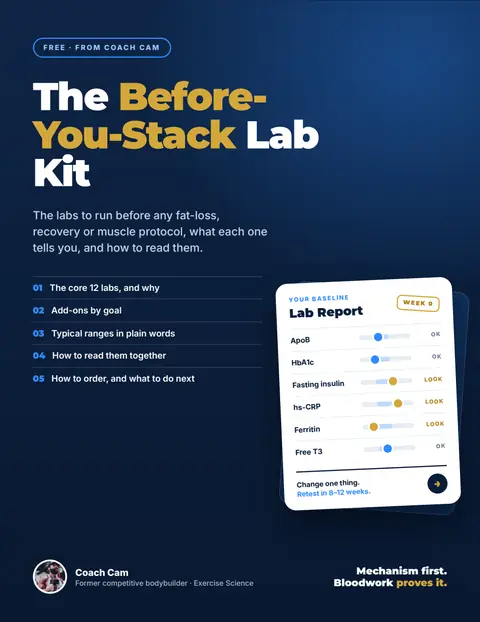
The free Before‑You‑Stack Lab Kit
The 12 labs I’d run before any protocol, what each one tells you, add-ons by goal and how to order them yourself. The PDF is yours straight away.
After that it is about two emails a week: a marker, a compound or a protocol. Unsubscribe in one click.
Everything else about Carnitine, Total and Free
What can skew the result
3 things can change the reading or the real level
Some change your real level; others only change the reading. Each one says which, and what to do about it.
- Valproate, pivalate antibioticsDrug or supplement
Valproate and pivalate-containing antibiotics both deplete carnitine substantially over months of use, by conjugating it and forcing renal loss.
Do this: Note any long-term use — it is the likeliest explanation for a low result.
A real change — account for the cause- Kidney impairment and dialysisPhysiological state
Alters carnitine handling markedly in both directions depending on stage.
Do this: Interpret alongside kidney function.
A real change — retest once it passes- Fasting stateTiming
Rises after eating, so a non-fasted draw measures your breakfast rather than your baseline.
Do this: Draw fasted, 10–12 hours, water only.
The value is real but reflects a moment — retime it
Symptoms it helps explain
1 symptom, and which to test first
Then worth checking for
- I take a lot of supplements — is any of it actually working?
Plan of attack
What to do, in this order
- Confirm the number is real
Fasting state. Rises after eating, so a non-fasted draw measures your breakfast rather than your baseline. Draw fasted, 10–12 hours, water only.
- Read it with its partner
Order with TMAO if supplementing chronically. Draw it alongside: TMAO (Trimethylamine N-oxide), Comprehensive Metabolic Panel (CMP), Free T3 (Triiodothyronine).
- Work out which direction is yours
If it's high — Supplementation — but note carnitine is converted by gut bacteria into TMAO, which is associated with cardiovascular risk. Worth pairing the two tests.
If it's low — Fatigue, muscle weakness, exercise intolerance, and impaired fat oxidation. - Fix it in order: food, then cause, then everything else
Nutrition. Red meat is the main dietary source; the body also synthesizes it from lysine and methionine.
Lifestyle. No specific lifestyle lever. - Retest
12 weeks after starting supplementation. Change one thing at a time, or the retest can't tell you which thing worked.
Where the optimal range comes from
No defensible optimal range
No defensible optimal range. Nobody has anchored this marker to an outcome, or the assay is not standardized enough for a number to travel between labs.
- Measured in
- No reference population with an outcome anchor in healthy adults.
- Anchored to
- None established. Plasma free and total carnitine are used to diagnose primary and secondary carnitine deficiency — inborn transporter defects, valproate therapy, dialysis — and that is a diagnostic question, not an optimization one.
- Source
- No guideline body publishes an optimal plasma carnitine concentration for healthy adults.
Carnitine status in a healthy omnivore is defended by both diet and endogenous synthesis, and the kidney reabsorbs it efficiently, so the plasma level sits in a narrow band regardless of intake. The people in whom a number genuinely changes management are those on valproate, on dialysis, with a suspected transporter defect, or long-term strict vegetarian with symptoms — not people looking for a fat-oxidation edge. A mid-range result carries no information about muscle carnitine, which is where the physiology happens and which needs a biopsy.
What Carnitine, Total and Free measures
And why people check it
What it tells you
A compound that shuttles long-chain fatty acids into mitochondria to be burned for energy.
Why people check it
Central to fat oxidation and mitochondrial energy production. Deficiency is uncommon but meaningful in vegetarians, dialysis patients, and certain metabolic conditions — and it's relevant to the TMAO conversation.
What Carnitine, Total and Free means next to other markers
1 pattern worth knowing
- The plant-based gap
B12 low · Ferritin low · Carnitine low · Vitamin D low · Zinc low
A well-run plant-based diet is fine, but four nutrients are genuinely harder to get and this combination shows a diet that has not been supplemented deliberately.
B12 is non-negotiable and non-optional — deficiency causes irreversible neurological damage. Add iron with vitamin C away from tea and coffee, plus vitamin D, zinc and an algal omega-3. Retest in 3 months.
Panels that carry Carnitine, Total and Free
3 panels, prices with code CAMERON
Read it alongside
Related markers, goals and what moves it in the library
Related markers
Goals it helps decide
In the library: what moves it
The deep read, with sources
What the Carnitine, Total and Free test actually measures, and the references
What Carnitine, Total and Free actually measures — the analyte, and the assay
The report gives you two numbers — free carnitine and total carnitine — and the interesting quantity is neither of them. It is the difference: total minus free is the acylcarnitine fraction, the carnitine currently carrying fatty acyl groups, and the acyl-to-free ratio is what actually changes in disease.
Two methods, measuring different things. Routine clinical chemistry uses an enzymatic cycling assay to give the free and total fractions — that is the method used to follow carnitine kinetics in a randomized withdrawal trial in hemodialysis patients Sugiyama 2021. The other is tandem mass spectrometry, which does not give you a total at all but a profile of individual acylcarnitine species, and that profile is what the fatty-acid oxidation disorders are actually diagnosed on Ruiz-Sala 2021.
The caution in that literature is the one readers need. The review of biochemical markers for these disorders warns explicitly that interpretation differs by age, by clinical situation, and by the type of sample or technique Ruiz-Sala 2021. A dried blood spot, a fasting plasma and a fed plasma are not interchangeable, and newborn screening programs have generated false positives and carrier detections precisely because the same number means different things in different contexts Ruiz-Sala 2021.
There is also a compartment question, and it has been measured. The hemodialysis trial profiled acylcarnitines in both plasma and red blood cells, and the signal that tracked cardiac status was an RBC ratio: changes in the red-cell (C16 + C18:1)/C2 acylcarnitine ratio correlated with changes in plasma BNP (β = 0.389, p = 0.005) Sugiyama 2021. The totals did not carry that. A single plasma total is the least informative thing you can extract from this analyte.
Carnitine, Total and Free: what changes the blood, and what only changes the reading
What changes the carnitine in your body:
- Diet — carnitine is largely red meat and dairy. But note the direction of the adaptation: bioavailability is higher in vegetarians than in meat eaters Alhasaniah 2023, which is why a low-meat diet does not simply produce a low plasma carnitine.
- Endogenous synthesis from lysine and methionine, which continues regardless of intake.
- Renal reabsorption, efficient enough that the kidney is the main regulator of the plasma pool — which is why carnitine deficiency appears in dialysis and in transporter defects rather than in ordinary diets Alhasaniah 2023.
- Drugs and disease. Valproate is the classic pharmacological cause; hepatic and renal disease, cirrhosis, sepsis and organic acidurias are the classic pathological ones Alhasaniah 2023.
- Severe undernutrition. In 56 female inpatients with eating disorders at a median BMI of 13.8 kg/m², 57% were carnitine deficient or pre-deficient on admission Imaeda 2024.
- Withdrawal of supplementation. Reducing intravenous L-carnitine from three times weekly to once weekly, or to placebo, significantly lowered plasma carnitine fractions and red-cell free carnitine over six months (p < 0.001), and stopping it entirely raised plasma BNP (p = 0.03) Sugiyama 2021.
What changes only the reading:
- Fed versus fasted, and recent exercise. Both shift carnitine into acyl esters, which moves the free fraction without changing the total pool.
- Sample type — plasma, red cell and dried blood spot are three different answers Ruiz-Sala 2021 Sugiyama 2021.
- Which method ran it, enzymatic total or MS/MS profile.
- A recent supplement dose, which measures the capsule rather than the person.
Reference interval or decision threshold — which kind of number Carnitine, Total and Free is
A reference interval, and an unusually tight one, because the analyte is defended by three mechanisms at once. Diet, endogenous synthesis and renal reabsorption each buffer the plasma pool Alhasaniah 2023, so a healthy omnivore and a long-term vegetarian sit closer together than intake alone would predict. The printed 30–89 µmol/L total and 22–66 µmol/L free describe that defended band.
Nothing above the floor is anchored to an outcome in healthy adults. Where thresholds exist they are diagnostic: free carnitine below 20 µmol/L was used to define deficiency and 20 to 36 µmol/L pre-deficiency in the refeeding cohort, against a healthy control group Imaeda 2024. Those are cut-offs for identifying a treatable state, not for optimizing anybody.
The critical-care consensus reaches the same place from a different direction: basal needs should be met, higher doses given where requirements are known to be higher, identified deficiencies treated — and high-dose monotherapy of a micronutrient is not recommended de Man 2024. Carnitine is on that list.
The people in whom this number changes management are on valproate, on dialysis, severely undernourished, or being investigated for a transporter defect or a fatty-acid oxidation disorder Ruiz-Sala 2021 Alhasaniah 2023 Imaeda 2024. That is the population the reference interval was built around.
How you would know your Carnitine, Total and Free was wrong — and when to redraw
Six to twelve weeks, and the pool moves faster than that. Plasma and red-cell carnitine fell significantly within a six-month randomized withdrawal, and the arm that dropped to once-weekly dosing separated from the arm that stopped altogether Sugiyama 2021, so the analyte responds to a change in supply on a scale of weeks. Twelve weeks is chosen for the symptom, not for the molecule.
Conditions that must match: same fasting state, same sample type, same method, and supplements held for at least 24 hours — otherwise the second draw measures the last dose Ruiz-Sala 2021.
How you would know your carnitine was wrong. Ask for the acyl-to-free ratio rather than the total, because that is the quantity that moved in the trial data Sugiyama 2021. Then draw TMAO, which carries the falsifiable prediction in the other direction: gut bacteria convert dietary carnitine to trimethylamine, hepatic flavin monooxygenases FMO1 and FMO3 oxidize it to TMAO, and TMAO concentrations track cardiovascular, renal and metabolic disease Gatarek 2021. If you are taking grams of carnitine daily and TMAO is climbing, the supplement is doing something measurable and it is not the thing you wanted. Add a CMP, because the kidney is what defends the pool Alhasaniah 2023, and free T3 if the reason for the test was fatigue rather than fat oxidation.
What Carnitine, Total and Free cannot tell you
Plasma carnitine is not muscle carnitine, and muscle is where the fatty-acid shuttle actually runs. The compartment you care about needs a biopsy, and no plasma value substitutes for it.
A normal total does not exclude a problem, because the informative quantity is the acylcarnitine pattern rather than the sum Ruiz-Sala 2021.
A low value in a vegetarian is usually the transporter doing its job, not a disease — absorptive efficiency rises as intake falls Alhasaniah 2023.
It cannot tell you whether fat oxidation is limited by carnitine. That is a flux question and this is a concentration. The randomized evidence for carnitine supplementation sits in dialysis, inborn errors, valproate toxicity and severe undernutrition Sugiyama 2021 Alhasaniah 2023 Imaeda 2024 — not in healthy people looking for an edge.
The wrong inference runs both ways on this page. A low-normal value read as a fat-loss lever is one error; a mid-range value read as ‘carnitine is fine, so supplementing is harmless’ is the other — harmless is not what the TMAO pathway says Gatarek 2021.
Sources read for these sections
- Ruiz-Sala P, et al. Biochemical Markers for the Diagnosis of Mitochondrial Fatty Acid Oxidation Diseases. Journal of Clinical Medicine 2021 · PMID 34768374
- Alhasaniah AH. l-carnitine: Nutrition, pathology, and health benefits. Saudi Journal of Biological Sciences 2023 · PMID 36632072
- Sugiyama M, et al. Effects of Reducing L-Carnitine Supplementation on Carnitine Kinetics and Cardiac Function in Hemodialysis Patients: A Multicenter, Single-Blind, Placebo-Controlled, Randomized Clinical Trial. Nutrients 2021 · PMID 34073024
- Imaeda M, et al. Secondary carnitine deficiency during refeeding in severely malnourished patients with eating disorders: a retrospective cohort study. Journal of Eating Disorders 2024 · PMID 38982532
- Gatarek P, et al. Trimethylamine N-oxide (TMAO) in human health. EXCLI Journal 2021 · PMID 33746664
- de Man AME, et al. What do we know about micronutrients in critically ill patients? A narrative review. JPEN Journal of Parenteral and Enteral Nutrition 2024 · PMID 39555865
Carnitine, Total and Free questions
6 answered
- What is a normal Carnitine, Total and Free level?
- Women: Similar, slightly lower. Men: Total 30–89 µmol/L, free 22–66 µmol/L. Ranges vary by laboratory and assay; always compare to the range printed on your own report.
- What is the optimal Carnitine, Total and Free level?
- Women: Same. Used diagnostically for carnitine deficiency, not as a number to raise. Men: No established optimum. Plasma carnitine is defended by diet, synthesis and renal reabsorption, so it sits in a narrow band regardless of intake. No guideline body publishes an optimal plasma carnitine concentration for healthy adults.
- What does a high Carnitine, Total and Free mean?
- Supplementation — but note carnitine is converted by gut bacteria into TMAO, which is associated with cardiovascular risk. Worth pairing the two tests.
- What does a low Carnitine, Total and Free mean?
- Fatigue, muscle weakness, exercise intolerance, and impaired fat oxidation.
- How often should I retest Carnitine, Total and Free?
- 12 weeks after starting supplementation.
- How do I test Carnitine, Total and Free?
- Through Marek Diagnostics without a doctor's visit, drawn at a Quest Diagnostics location in the US. Code CAMERON applies 10% off automatically through the links on this page.
Sources: Koeth RA et al., Nat Med 2013 — carnitine, gut microbiota and TMAO.
The Metabolic Health & Prediabetes protocol is a lesson in Skool
This page tells you what the number means and the order to act in. Skool is where it becomes a plan for your situation, read against your own labs.
- The full Metabolic Health & Prediabetes protocol, step by step
- Supplement form, timing and how long to run it
- The hormones and compounds that move it, and what to watch
5.0 (15 reviews)1,500+ members

Want it built around you?
Educational and research purposes only. Not medical advice; talk to your clinician about results. Lab ranges vary by assay and laboratory: compare against the range printed on your own report. Some links are affiliate links; Cam may earn a commission at no extra cost to you. Medical disclaimer and affiliate disclosure