What to expect, and when
Brightness at 6–12 weeks.
How to use Vitamin C Infinity Cream
AM, and keep it away from your copper peptide. Vitamin C and GHK-Cu deactivate one another — vitamin C morning, copper night.
Does Vitamin C actually work on skin?The evidence: clinical, correlative, mechanism
This is a different question from whether it works injected, and the answer is often different too — a molecule has to survive the stratum corneum before any of its biology matters.
Human clinical evidence
Controlled trials of L-ascorbic acid at 10–20% report reduced hyperpigmentation, improved evenness and modest collagen support. Strong for tone; weaker than retinol for wrinkles.
Well established as a photoprotective adjunct — it does not replace SPF but measurably reduces UV-induced damage under it.
Correlative data
Decades of cosmetic use and one of the few actives where users reliably report a visible change in tone within weeks.
How the mechanism reads
The catch is chemistry, not biology: L-ascorbic acid oxidizes. A serum that has gone yellow or brown has already converted to dehydroascorbic acid and is doing less. Buy small, opaque, and replace it.
It also deactivates copper peptides in the same layer — run vitamin C in the morning and copper at night.
L-ascorbic acid needs a pH under roughly 3.5 to cross the skin, which is exactly the pH at which it is least stable in the bottle — the central formulation tension of the ingredient. Oxidation shows as a color shift toward yellow then brown, and a browned serum is not just weaker, it is a solution of dehydroascorbic acid you are rubbing into your face.
This is the one direct conflict in the whole cosmetics section: ascorbic acid and copper peptides deactivate each other in the same layer — the copper drives oxidation of the vitamin C, and the vitamin C reduces the copper. They are not incompatible in a routine, only in a layer. Vitamin C in the morning, copper peptides at night, and both keep working.
What bloodwork can and cannot tell you here5 markers behind the problem a cream cannot reach
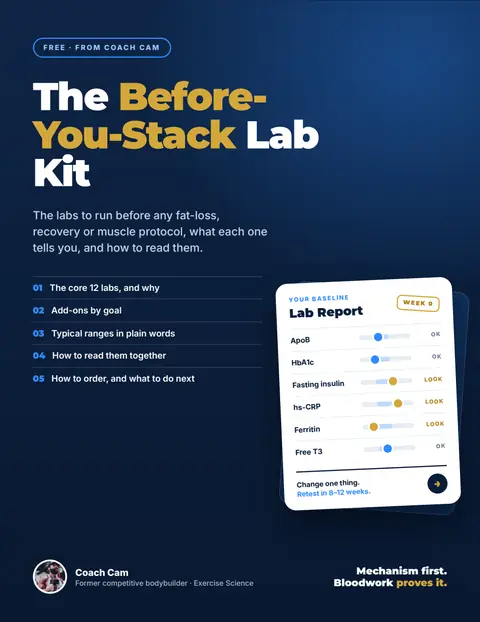
None of this shows up in your bloodwork, and anyone telling you otherwise is selling something. A cosmetic is a local intervention: the actives small enough to cross the stratum corneum act on the fibroblasts and keratinocytes in the millimetre underneath it, and the amount reaching your circulation is nowhere near enough to move a serum number. That is not a criticism of the product. It is the reason a lab result cannot tell you whether it is working, and the reason the honest measurement is a photograph in the same light twelve weeks apart.
What blood work is for here is the half of skin aging a cream cannot reach. Intrinsic aging is glycation, chronic inflammation and the substrate your fibroblasts have to build with — all measurable, all correctable, and all of it working against the serum while you use it.
Topical L-ascorbic acid works in the skin it is applied to. The oxalate and iron-absorption questions the Vault raises about vitamin C belong to gram doses taken by mouth; a serum does not raise plasma vitamin C and does not carry those questions with it.
The Longevity Baseline panel covers these in one order: 13 markers, $219.10 with the discount applied.
Collagen synthesis & dermal matrix: the internal side of the same problem, and what to do about it