What to expect, and when
Treat as a GHK-Cu product unless applied to needled skin.
How to use Transdermal KLOW
Applied to skin. Note that of the four peptides in KLOW, only GHK-Cu is small enough to reliably cross intact skin — see the KLOW card. It carries GHK-Cu, so it inherits the copper rule: not in the same layer as direct vitamin C.
Does KLOW actually work on skin?The evidence: clinical, correlative, mechanism
This is a different question from whether it works injected, and the answer is often different too — a molecule has to survive the stratum corneum before any of its biology matters.
Human clinical evidence
No controlled topical evidence for the blend as a blend. What exists belongs to the individual components, mostly injected.
Correlative data
A popular research blend (GHK-Cu, BPC-157, TB-500, KPV) sold transdermally as well as injected.
How the mechanism reads
Combines a copper signal peptide with two repair peptides and an anti-inflammatory tripeptide.
Only GHK-Cu is small enough to reliably cross intact skin. BPC-157 (~1,419 Da), TB-500 (~4,963 Da) and KPV are well above the practical penetration limit, so a transdermal version is largely a GHK-Cu product with expensive company — unless applied to broken or needled skin.
As a topical this is a convenience decision, not a mechanistic one: GHK-Cu, BPC-157, TB-500 and KPV in one application. The copper peptide is the only member with a real topical evidence base; the other three are being carried along on injection data and on the assumption they penetrate, which is unestablished.
The practical consequence is a layering one — everything the copper in GHK-Cu conflicts with, this conflicts with too. Keep it away from direct vitamin C in the same layer.
What bloodwork can and cannot tell you here5 markers behind the problem a cream cannot reach
None of this shows up in your bloodwork, and anyone telling you otherwise is selling something. A cosmetic is a local intervention: the actives small enough to cross the stratum corneum act on the fibroblasts and keratinocytes in the millimetre underneath it, and the amount reaching your circulation is nowhere near enough to move a serum number. That is not a criticism of the product. It is the reason a lab result cannot tell you whether it is working, and the reason the honest measurement is a photograph in the same light twelve weeks apart.
What blood work is for here is the half of skin aging a cream cannot reach. Intrinsic aging is glycation, chronic inflammation and the substrate your fibroblasts have to build with — all measurable, all correctable, and all of it working against the serum while you use it.
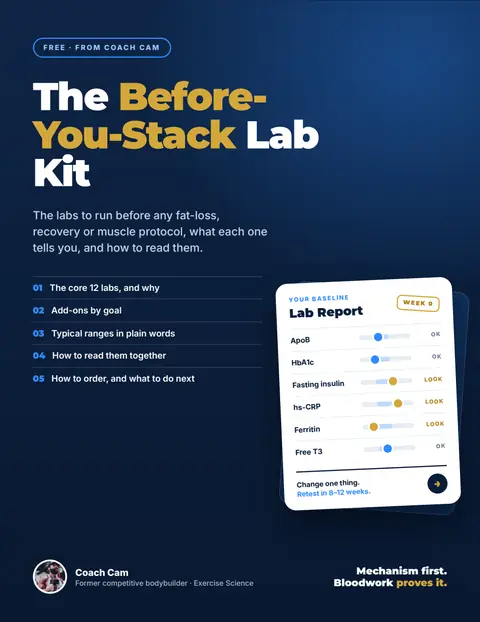
The Longevity Baseline panel covers these in one order: 13 markers, $219.10 with the discount applied.
Collagen synthesis & dermal matrix: the internal side of the same problem, and what to do about it