What to expect, and when
Unknown — read the Exosomes card first.
How to use ProExosome
Post-procedure only is the honest recommendation. On intact skin, vesicle penetration is not established. Best used on freshly cleansed or just-microneedled skin, where the barrier is most permeable. Nothing occlusive underneath it.
Does Exosomes actually work on skin?The evidence: clinical, correlative, mechanism
This is a different question from whether it works injected, and the answer is often different too — a molecule has to survive the stratum corneum before any of its biology matters.
Human clinical evidence
No standardized controlled human evidence for topical cosmetic use. Regulators including the FDA have warned about unapproved *injectable* exosome products after adverse events — a statement about oversight, not about benefit.
Correlative data
Common in clinics straight after microneedling or laser, with practitioner reports of faster settling. Note the confound: that is exactly when the barrier is open and when recovery is watched closely anyway.
Independent testing of commercial products has repeatedly found particle counts and vesicle integrity far below label claims.
How the mechanism reads
30–150 nm vesicles carrying miRNA, mRNA and proteins between cells. Real biology, seriously studied.
Three unsolved problems sit between that and a bottle: no standard (the word names a claimed source, not a dose or a cargo), fragility (processing and storage degrade them), and penetration of an intact vesicle through healthy skin is not established.
Unproven is not ineffective — but nobody can tell you what a given bottle contains, and that uncertainty is the product you are buying. Price it in.
The category has a labeling problem more than a science problem. True exosomes are nanovesicles carrying signaling cargo; a large share of products labeled 'exosome' are lysates or conditioned media — the contents of broken cells, not intact vesicles — and the two behave differently.
Source and processing decide what is in them, and neither is usually disclosed. The honest position is that the mechanism is real and the products are unstandardized, which makes any individual result hard to attribute and impossible to reproduce across brands.
What not to layer with ProExosome1 pairing to keep apart
- Exosomes + Intact skin — The only setting with a real rationale is immediately post-procedure. On unbroken skin, penetration of an intact vesicle is not established.
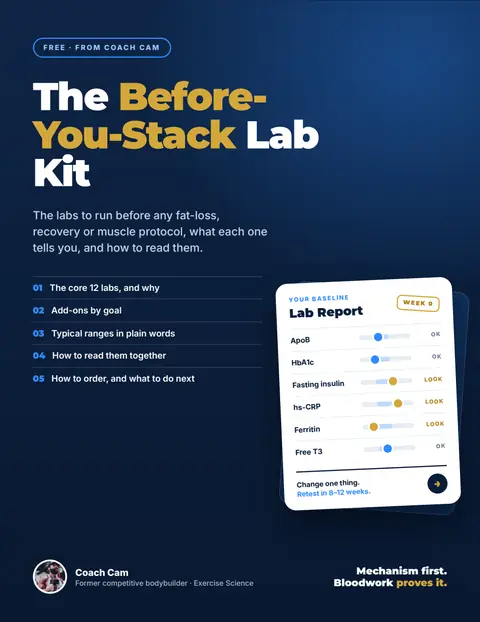
What bloodwork can and cannot tell you here5 markers behind the problem a cream cannot reach
None of this shows up in your bloodwork, and anyone telling you otherwise is selling something. A cosmetic is a local intervention: the actives small enough to cross the stratum corneum act on the fibroblasts and keratinocytes in the millimetre underneath it, and the amount reaching your circulation is nowhere near enough to move a serum number. That is not a criticism of the product. It is the reason a lab result cannot tell you whether it is working, and the reason the honest measurement is a photograph in the same light twelve weeks apart.
What blood work is for here is the half of skin aging a cream cannot reach. Intrinsic aging is glycation, chronic inflammation and the substrate your fibroblasts have to build with — all measurable, all correctable, and all of it working against the serum while you use it.
Exosome skincare has no standardized human topical evidence, and regulators have issued warnings about unapproved injectable exosome products. Neither of those facts produces a marker you can measure, and no lab test will tell you whether a vesicle preparation did anything.
The Longevity Baseline panel covers these in one order: 13 markers, $219.10 with the discount applied.
Collagen synthesis & dermal matrix: the internal side of the same problem, and what to do about it