
What to expect, and when
Condition immediately.
How to use GHK-Cu Copper Peptide Conditioner
After shampoo. Mid-length to ends. Keep it out of the same layer as direct vitamin C — copper and ascorbic acid deactivate each other. Vitamin C in the morning, copper peptides at night, and both keep working.
Does GHK-Cu actually work on skin?The evidence: clinical, correlative, mechanism
This is a different question from whether it works injected, and the answer is often different too — a molecule has to survive the stratum corneum before any of its biology matters.
Human clinical evidence
The best-evidenced peptide in this section for topical use, and unusually it is evidenced as a topical specifically rather than borrowed from injection studies. Controlled work reports increased collagen and elastin, improved skin firmness and reduced fine lines over 12 weeks in facial creams, and improved wound closure in dermatology settings.
Correlative data
Decades of use in cosmetic dermatology, and one of very few peptides that survived from prescription wound care into ordinary skincare on the strength of results rather than marketing.
Scalp use for density is widespread and reported experience is positive but slow — months, not weeks — and far less dramatic than minoxidil.
How the mechanism reads
A copper-binding tripeptide (glycyl-L-histidyl-L-lysine) at about 340 Da — small enough to actually cross the stratum corneum, which is why it works topically when larger peptides do not. It upregulates collagen I, III and IV and elastin, signals metalloproteinase remodeling, and delivers copper as a cofactor for lysyl oxidase, the enzyme that cross-links collagen.
The copper is the caveat. It is what makes it work and also what makes it stain, oxidize and interact badly with direct vitamin C in the same layer. Separate them by routine, AM and PM.
What not to layer with GHK-Cu Copper Peptide Conditioner1 pairing to keep apart
- GHK-Cu + Vitamin C — Copper peptides and direct (L-ascorbic) vitamin C deactivate each other. Not dangerous — just wasteful. Split them: vitamin C in the morning, copper peptide at night.
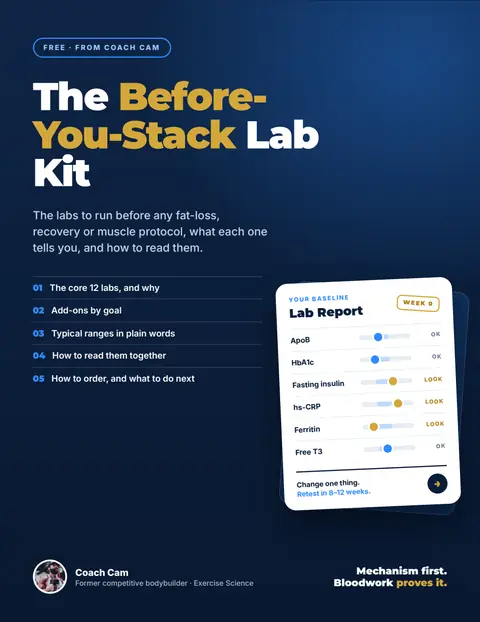
What bloodwork can and cannot tell you here7 markers behind the problem a cream cannot reach
A topical works on the follicle from the outside, and it will not show up in a blood test. What it also cannot do is change the reason the follicle is miniaturizing or shedding — and in a large share of people that reason is internal, measurable and correctable.
This is the most useful thing on the page, and it is worth more than the shampoo. Diffuse shedding is very often low iron, thyroid disease or a zinc deficiency, none of which any serum touches, and all of which are cheap to find. Pattern loss is DHT at a genetically sensitive follicle, which is a different problem with a different answer. The point of running this first is that it tells you which of the two you have.
GHK-Cu is a copper peptide, and the Vault does carry a copper-load warning for it — attached to the injected form, where it belongs. At cosmetic concentrations on intact skin there is no evidence that a serum, cream or shampoo raises serum copper or ceruloplasmin, and a copper level is not a way to judge whether the product is working. If you are also injecting GHK-Cu, that is where the question lives, and the compound page is where it is answered.
The Male Hair Loss — What Blood Can and Cannot Tell You panel covers these in one order: 10 markers, $160.65 with the discount applied.