The short version
- What it doesBeta-alanine is not the active molecule and is not stored. It is the rate-limiting brick for one dipeptide.
- Who it is forAthletes in the 1–4 min power-endurance range (lifting, sprint intervals, CrossFit).
- What to watchParaesthesia — tingling and prickling of the face, neck and hands — is expected, harmless and the reason most people ask about it. It peaks around 15 minutes and fades. Splitting the dose or using sustained-release avoids it.
How Beta-Alanine works
Beta-alanine is the rate-limiting precursor for carnosine, the dipeptide that acts as the main intracellular pH buffer in fast-twitch muscle. Supplementing raises muscle carnosine substantially over four to eight weeks, which delays the hydrogen ion accumulation that ends a hard set.
Read the rest of how it works
The tingling — paraesthesia — comes from beta-alanine transiently activating MrgprD receptors on sensory nerves and is harmless.
Beta-Alanine: serving, timing and spacing
- Suggested serving
- 3–5 g daily (sustained-release reduces the harmless tingling); benefits accrue over weeks.
- How often
- Daily
- When
- Split into 2-4 doses to blunt the tingling - the paraesthesia tracks the peak concentration, not the total. Timing relative to training is irrelevant; you are loading muscle carnosine over weeks
General referenceA general reference intake for education, not a prescription. The label on the product you buy is the final word.
Good to know: The skin tingle (paresthesia) is harmless; SR forms minimize it.
Research on Beta-Alanine4 evidence notes: clinical, correlative, theoretical
Each note sits under the kind of evidence it stands on. A thin or missing trial means nobody has run it yet, not that it doesn’t work. How the evidence tiers work
Human clinical evidence
Meta-analyses show improved performance in efforts lasting 1–4 minutes (the acid-buffering window).
Increases training volume and time-to-exhaustion in repeated high-intensity work.
Correlative data
Higher muscle carnosine tracks with better anaerobic capacity.
Theoretical / extrapolated benefits
Carnosine's antioxidant/anti-glycation roles are proposed for healthy aging — early and unproven at supplemental doses.
Sources read for this page
- Cesak O, et al. Carnosine and Beta-Alanine Supplementation in Human Medicine: Narrative Review and Critical Assessment. Nutrients 2023 · PMID 37049610
- Matthews JJ, et al. Effect of Carnosine or beta-Alanine Supplementation on Markers of Glycemic Control and Insulin Resistance in Humans and Animals: A Systematic Review and Meta-analysis. Advances in Nutrition 2021 · PMID 34333586
- Blancquaert L, et al. Acute preexercise supplementation of combined carnosine and anserine enhances initial maximal power of Wingate tests in humans.. Journal of Applied Physiology 2021 · PMID 33914660
- Saadati S, et al. Carnosine Did Not Affect Vascular and Metabolic Outcomes in Patients with Prediabetes and Type 2 Diabetes: A 14-Week Randomized Controlled Trial. Nutrients 2023 · PMID 38004228
- Oppermann H, et al. Erythrocytes Prevent Degradation of Carnosine by Human Serum Carnosinase.. International Journal of Molecular Sciences 2021 · PMID 34884603
- de Jager S, et al. Acute balenine supplementation in humans as a natural carnosinase-resistant alternative to carnosine. Scientific Reports 2023 · PMID 37081019
- Toviwek B, et al. Binding Modes of Carnostatine, Homocarnosine, and Ophidine to Human Carnosinase 1. ACS Omega 2023 · PMID 38024708
Beta-Alanine, the deep readThe mechanism, cell to human, which form, how you would know
What Beta-Alanine actually does
Beta-alanine is not the active molecule and is not stored. It is the rate-limiting brick for one dipeptide. Carnosine is beta-alanyl-L-histidine, assembled inside the muscle fiber by carnosine synthase. Histidine is abundant; beta-alanine is not, and its concentration inside the fiber sits far below the enzyme's Michaelis constant. Supplying more beta-alanine therefore raises carnosine almost linearly, which is why this supplement works on its own marker with unusual reliability Cesak 2023.
What carnosine does in the fiber is buffer a proton at exactly the right pH. Its imidazole ring has a pKa near 6.8 — inside the range muscle pH falls to during intense glycolytic work — so it accepts protons precisely where bicarbonate and phosphate buffers are already spent. Carnosine contributes perhaps 7 to 15 percent of total intracellular buffering, and more in type 2 fibers, which hold roughly twice the concentration of type 1.
It has three other documented activities that the buffering story tends to swallow. It chelates copper and zinc, it scavenges reactive carbonyls including 4-hydroxynonenal and methylglyoxal, and it improves calcium sensitivity of the contractile apparatus in skinned fibers. Those are the mechanisms behind the metabolic and anti-glycation claims, and they are the ones with the weakest human evidence.
Humans have an enzyme in blood that rodents do not, and it wrecks the obvious shortcut. Serum carnosinase 1 hydrolyzes circulating carnosine within minutes, which is why swallowing carnosine itself is an inefficient way to raise muscle carnosine and why animal data on oral carnosine do not transfer. The enzyme's substrate preferences have been mapped against carnosine analogs Toviwek 2023, and erythrocytes have been shown to protect carnosine from it in circulation Oppermann 2021. Beta-alanine's whole commercial existence is a way around that enzyme.
The paresthesia is a separate receptor and not a side effect of the mechanism. Beta-alanine is an agonist at MrgprD on cutaneous sensory neurons, which produces the tingling of the face, scalp and hands 15 to 30 minutes after a dose. It is dose-related, harmless and unrelated to whether carnosine is rising.
Cell, rodent, human — and where it stops
The marker on this page is measured in the tissue itself, which is rare and good. What has not transferred is everything the marker was supposed to predict outside a narrow window of exercise.
In muscle biopsy studies the loading curve is well characterized. Four to six grams a day for four weeks raises muscle carnosine by roughly 40 to 60 percent, ten weeks raises it further, and the increase is larger in people who started low — vegetarians, women, and older adults Cesak 2023.
The performance outcome transferred, and only inside a duration window. Effects concentrate on efforts lasting roughly 1 to 4 minutes, where glycolytic proton accumulation is the limiting factor. Below about 30 seconds, phosphocreatine dominates and there is nothing for carnosine to buffer. Above about 10 minutes, the effort is oxidative and pH is not the constraint. The window is narrow and it is the clearest statement of what this product does.
The acute claims do not transfer at all, and one experiment shows why. Supplying carnosine and anserine acutely before exercise enhanced initial maximal power in Wingate tests Blancquaert 2021, which is an acute plasma effect rather than a chronic muscle loading effect. Beta-alanine taken before a session does nothing, because carnosine synthesis takes weeks.
And the metabolic claims collapsed when somebody tested them. A systematic review and meta-analysis of carnosine or beta-alanine on glycemic control and insulin resistance found the human evidence far weaker than the animal evidence Matthews 2021, and a 14-week randomized controlled trial in prediabetes and type 2 diabetes found carnosine did not affect vascular or metabolic outcomes Saadati 2023. The muscle marker rose in those trials. The metabolism did not.
The obstacle to transfer has a name and it is a serum enzyme. Rodents have negligible serum carnosinase, so rodent carnosine circulates and reaches tissue; humans hydrolyze it within minutes Toviwek 2023 Oppermann 2021. Every animal study of systemic carnosine action is describing an exposure a human cannot achieve, and work on carnosinase-resistant analogs exists precisely because of it de Jager 2023.
Beta-Alanine — which form, and does it matter
The form choice on this shelf is a release-rate choice and it exists to manage one nerve receptor. Plain beta-alanine at 1.6 g produces reliable paresthesia; sustained-release formulations spread the same dose over hours, flatten the plasma peak below the MrgprD threshold, and deliver the same daily total with less tingling. Retention is comparable, so this is a tolerability technology rather than an absorption one Cesak 2023.
Carnosine itself is the form that does not work, and the reason is enzymatic. Oral carnosine is hydrolyzed by intestinal and serum carnosinase to beta-alanine and histidine, so it functions as an expensive and less efficient beta-alanine. Anserine and balenine — the methylated analogs found in poultry and whale muscle — resist the enzyme better, which is why acute balenine supplementation has been studied as a carnosinase-resistant alternative de Jager 2023.
The exposure arithmetic is why the dose is split. Beta-alanine is absorbed by the PAT1 and TauT transporters, peaks in plasma at roughly 30 to 40 minutes and is cleared with a plasma half-life of about 25 minutes, largely by muscle uptake and renal clearance. There is no cytochrome step. Muscle carnosine synthase then works slowly on whatever arrived. Because plasma clearance is fast and synthesis is slow, four 1.6 g doses through the day load more carnosine than one 6.4 g dose and cause far less tingling.
The clock is the longest of any ergogenic aid in this catalog. Muscle carnosine rises measurably by 2 weeks, is meaningfully loaded by 4 weeks, and continues rising to 10 or 12 weeks. Washout is slower still: the decay half-life of muscle carnosine after stopping is roughly 6 to 15 weeks, so a person who stops for a month has lost very little. Nothing about this product rewards taking it on the day of a competition.
One genuine interaction between forms. Beta-alanine and taurine share the TauT transporter, and chronic high-dose beta-alanine lowers muscle taurine in rodents. Human data are limited and the effect appears small; it is a reason to notice a stack containing both rather than a reason to avoid one.
What would have to be true, and how you would know it was not
1. The tingling arrives on day one and predicts nothing. Predict paresthesia within 15 to 30 minutes of a 1.6 g dose, proportional to peak plasma concentration, absent on a sustained-release product, and entirely unrelated to whether muscle carnosine is loading Cesak 2023. Anybody using the tingle as a sign it is working has the wrong read-out.
2. Predict the effect appears at four weeks and only in a specific effort. Predict a measurable improvement in a 1 to 4 minute maximal test — a 2,000 m row, a 400 to 800 m run, repeated 60-second intervals — after 4 weeks at 4 to 6 g a day, and no change in a 1-repetition maximum or a 10 km time. Test the same protocol before and after; the duration boundary is the prediction.
3. The prediction that cuts against the product. Predict no change in HbA1c, fasting insulin or any vascular measure at 14 weeks, because a randomized trial designed to detect exactly that returned nothing Saadati 2023 Matthews 2021. A well-powered metabolic trial showing benefit would falsify this page.
4. Predict the responders are the people who started low. Predict the largest carnosine increases and the largest performance changes in vegetarians and in women, whose baseline muscle carnosine is lower, and the smallest in a habitual meat eater doing sprint training already Cesak 2023.
5. Predict that oral carnosine does not substitute. Predict that an equal molar dose of carnosine raises muscle carnosine no more than beta-alanine does, because serum carnosinase hydrolyzes it before it can be taken up intact Toviwek 2023 Oppermann 2021. A study showing intact carnosine uptake into human muscle would overturn the reasoning here and would be genuinely important de Jager 2023.
What nobody has tested yet
The carnosinase genotype has never been used to stratify a trial. Serum carnosinase activity varies severalfold between people on a common polymorphism, and no exercise or metabolic trial has stratified on it Oppermann 2021. If circulating carnosine matters for anything, that is the variable that decides who responds, and nobody has looked.
Brain carnosine is unmeasured in supplemented humans. Carnosine is present in olfactory and other neural tissue and beta-alanine crosses into brain, and no human study has measured central carnosine after supplementation. Every claim about mood, cognition or neuroprotection from this compound rests on that gap.
The taurine displacement question is unresolved in people. Rodent work shows chronic beta-alanine lowering muscle taurine through shared transport; human biopsy data are sparse and short. Anyone taking beta-alanine for years is running an experiment nobody has reported.
And the anti-carbonyl claim has no human endpoint. Carnosine scavenges methylglyoxal and 4-hydroxynonenal in vitro, which is the basis for the anti-aging framing, and no trial has measured advanced glycation end products in supplemented humans over a meaningful period Matthews 2021. That is a straightforward study that would settle a large marketing claim.
Beta-Alanine — its own safety story, not its category's
Paresthesia is the defining effect and it is benign. Tingling and flushing of the face, scalp, neck and hands, beginning 15 to 30 minutes after a dose and lasting up to about an hour, dose-dependent above roughly 800 mg to 1 g in a single serving. It is receptor-mediated on sensory neurons, it does not indicate an allergic reaction, and splitting the dose or using a sustained-release form removes it Cesak 2023.
The safety database is decent for a sports supplement and short for a daily one. Trials have run to 24 weeks at 6.4 g a day without a consistent adverse signal, and there is no established tolerable upper intake level. What does not exist is multi-year data.
Two theoretical concerns that deserve honest labels. Taurine displacement through shared transport, which is demonstrated in rodents and unquantified in people. And histidine handling, since carnosine synthesis consumes histidine; no depletion has been demonstrated at supplemental doses.
Who has a specific reason to be careful. Anyone with a history of unexplained paresthesia or a peripheral neuropathy, because this product produces a symptom that would otherwise be worth investigating and can mask it. Anyone with impaired renal clearance, since beta-alanine is renally cleared and no dosing study exists in that population. And pregnancy and lactation, where there are no data.
What the page will not claim. It will not present a buffering agent as a metabolic or anti-aging intervention. The buffering claim is supported inside a narrow effort duration; the metabolic claim was tested and returned nothing Saadati 2023. Nothing here is medical advice or diagnosis, and these statements have not been evaluated by the Food and Drug Administration.
Beta-Alanine safety basics3 points of its own
Its own safety story
- Paraesthesia — tingling and prickling of the face, neck and hands — is expected, harmless and the reason most people ask about it. It peaks around 15 minutes and fades. Splitting the dose or using sustained-release avoids it.
- No other common effects. Well tolerated at 3–6 g/day.
- Depletes taurine in theory with long-term use; the practical significance is unestablished. No significant drug interactions.
Not medical advice. If you take prescription medication or have a diagnosed condition, check this against it with a pharmacist or doctor. Pharmacists are underused and free.
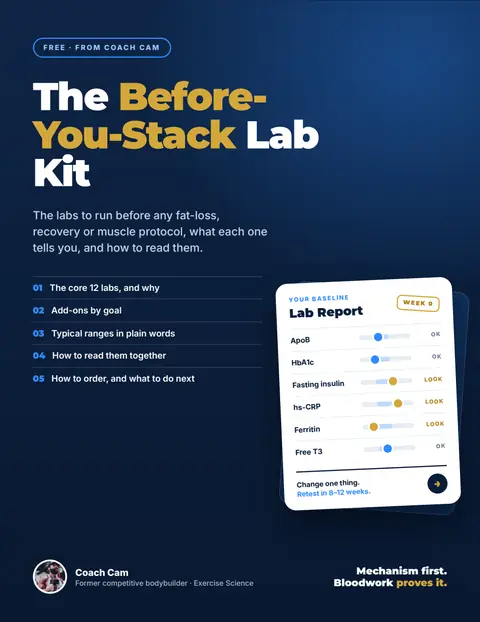
Bloodwork to run4 tests in one order, code CAMERON
The effect itself has no blood test. That is a fact about the effect, and it changes how you should judge it.
- What to watchTotal work inside the one window it acts on: efforts of roughly one to four minutes, where hydrogen ions are the limiter. Pick something repeatable — a 500 m row, a set of twenty at a fixed load, the same interval on the same bike — and record the number for two weeks before you start loading. Test it under 30 seconds or over ten minutes and you are outside what raised muscle carnosine buffers, and the null you get back will mean nothing.
- How long before it means anythingFour weeks at minimum, six is better. Muscle carnosine accumulates slowly with daily dosing, which is why the loading period rather than the individual serving is the dose — a scoop before a session does nothing except make your skin tingle.
- What will fool youThe tingle. Paresthesia arrives with the first dose, long before any carnosine has been built, and it is at once the most convincing thing about this product and the least informative: people read it as the supplement working. It is not. Then the usual — if this came inside a pre-workout you are also testing caffeine and citrulline, and on any single session the caffeine is doing more of the work than the beta-alanine is.
The labs mapped to Beta-Alanine
Code CAMERON applies automatically at checkout. Draw before you start, not after: a result with nothing to compare it to answers nothing.
Beta-Alanine FAQ5 common questions
- What is Beta-Alanine?
- An amino acid that raises muscle carnosine, buffering the acid build-up that limits high-intensity effort.
- What is the suggested dose of Beta-Alanine?
- 3–5 g daily (sustained-release reduces the harmless tingling); benefits accrue over weeks. This is a general reference for education only. Statements have not been evaluated by the FDA and this is not medical advice.
- Who is Beta-Alanine for?
- Athletes in the 1–4 min power-endurance range (lifting, sprint intervals, CrossFit).
- Which labs show whether Beta-Alanine is doing anything?
- Complete Blood Count (CBC) with Differential, Ferritin, Total Testosterone, Comprehensive Metabolic Panel (CMP). Draw a baseline before you start, then recheck.
- Where can I buy Beta-Alanine?
- Coach Cam sources Beta-Alanine from Thorne, with 10% off applied automatically at checkout. Use the buy link on this page.